
Determining Restroom Ratios for Commercial Job Sites: OSHA Standards and Practical Workflow
Learn how to calculate accurate portable restroom ratios for commercial construction sites by balancing OSHA compliance with real-world job site layout and workflow.
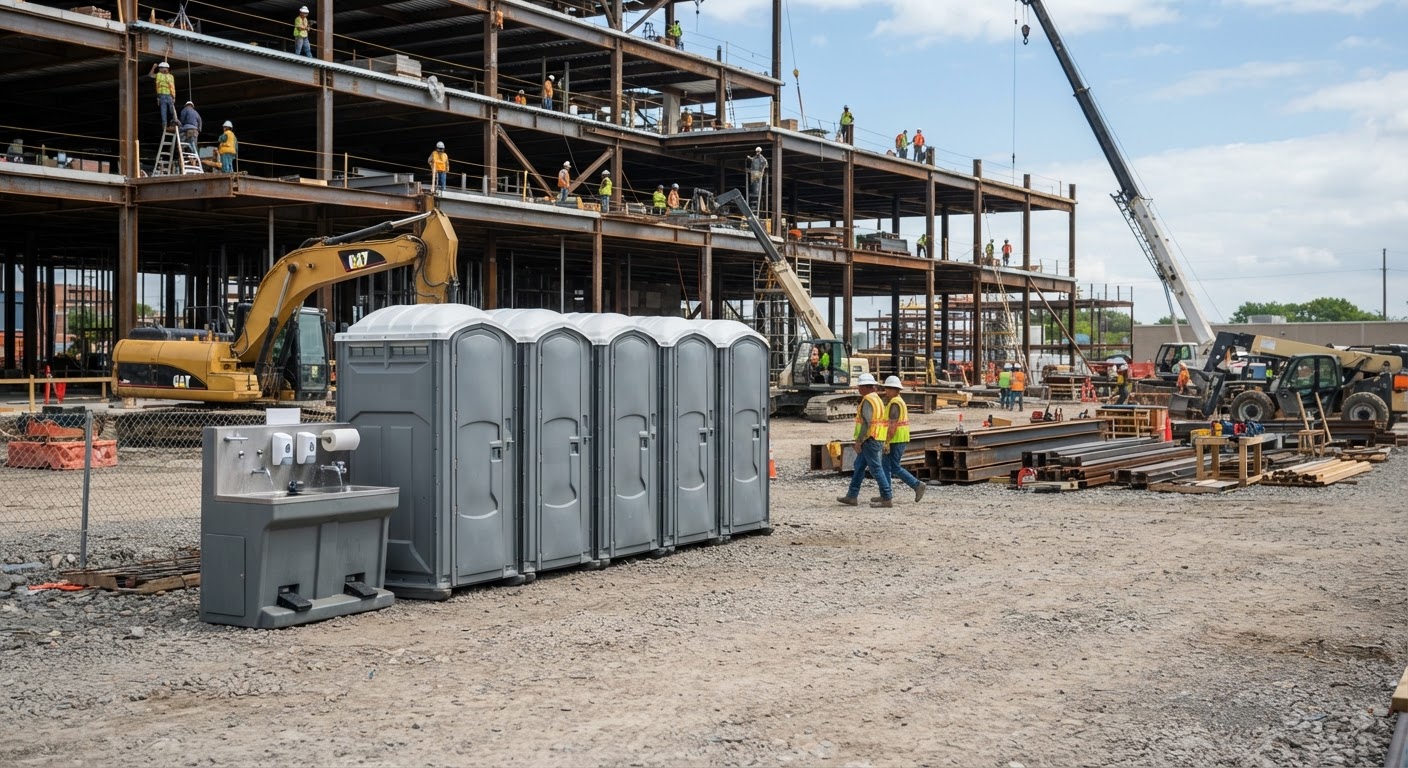
On commercial construction sites, sanitation planning is often treated as a peripheral administrative detail until problems emerge. Insufficient facilities, poorly maintained units, or long travel distances between the active work area and the nearest restroom lead directly to lost labor hours, compromised hygiene, and code violations. For project managers, general contractors, and site superintendents, determining the right ratio of portable restrooms requires navigating both mandatory regulatory benchmarks and the practical dynamics of day-to-day job site operations.
Understanding Federal OSHA Sanitation Standards
The primary regulatory baseline for job site sanitation in the United States is established by the Occupational Safety and Health Administration under 29 CFR 1926.51(c). This standard establishes the minimum number of facilities that an employer must provide on a construction site based on the number of workers on duty:
- 20 or fewer workers: At least 1 toilet facility.
- 20 to 199 workers: At least 1 toilet seat and 1 urinal per 40 workers.
- 200 or more workers: At least 1 toilet seat and 1 urinal per 50 workers.
While these figures define the minimum legal threshold, OSHA also mandates that restrooms must be accessible. The administration specifies that employers must ensure employees have prompt access to sanitary facilities when needed, without unreasonable restrictions or excessive transit times. Treating OSHA figures as an automatic target rather than an absolute minimum can quickly create functional bottlenecks on an active job site.
Why Baseline Ratios Fall Short in Practice
OSHA requirements assume static crew numbers and an ideal, centralized layout. Commercial projects rarely fit that description. Relying solely on the federal formula without assessing job-specific conditions can leave your crews under-equipped. Several practical variables determine whether your site needs additional capacity beyond the regulatory baseline.
Site Footprint and Transit Times
On large commercial developments, industrial park builds, or expanding retail developments—such as those seen throughout commercial zones in Sugarcreek Township and the broader Miami Valley—the physical distance across a parcel can be substantial. If a framer or electrician must walk ten minutes across uneven terrain, navigate safety barriers, and climb down scaffolding to reach a single bank of units near the main gate, a single trip can easily consume 25 to 30 minutes.
When multiplied across a full crew taking standard breaks, unoptimized placement drains dozens of productive labor hours each week. Placing portable restrooms closer to primary active zones—or distributing smaller clusters across the site rather than grouping every unit in one location—dramatically improves efficiency.
Vertical Travel on Multi-Story Projects
On multi-story commercial structures, horizontal distance is compounded by vertical travel. Waiting on material hoists or descending multiple flights of temporary stairs adds significant friction to simple routines. Industry best practices recommend placing units every two to three floors once upper decking and framing are secure, utilizing specialized crane-liftable units or rolling indoor models designed for tight interior floorplates.
Trade Stacking and Crew Surges
Job site headcounts are rarely constant. A project may operate with 15 workers during early foundation phases, only to experience a sudden surge to 80 or more during mechanical, electrical, and plumbing rough-ins. Standard weekly or monthly rental orders that are not adjusted in anticipation of subcontractor schedules can leave a site critically undersupplied during peak phases.
Superintendents should cross-reference projected staffing schedules with their restroom counts at least two weeks before major trade mobilizations. This allows for seamless delivery and prevents facilities from becoming overwhelmed.
Shift Patterns and Staggered Breaks
Peak restroom demand occurs in concentrated windows: during the morning arrival window, right at mid-shift meal breaks, and immediately before dismissal. Even if a site meets the 1-to-40 ratio on paper, having forty workers attempt to use a single unit within a 30-minute break window creates predictable lines, frustration, and extended breaks. Staggering crew break times helps mitigate this pressure, but adding supplementary units often provides the most direct relief.
Service Frequency as a Capacity Variable
Portable restroom capacity is a function of both unit count and service frequency. A standard calculation assumes one comprehensive service call per week. However, increasing service frequency can be an effective way to maintain high hygiene standards without overcrowding a site with excess physical units where laydown space is limited.
- Weekly Service: Suitable for small, stable crews operating on larger sites with ample room for the full recommended unit count.
- Bi-Weekly (Twice-Weekly) Service: Recommended for sites with 30 or more workers, fast-paced commercial turnarounds, or projects where footprint constraints limit unit drop locations.
- Daily or Multi-Day Service: Essential for large-scale operations with continuous shifts, intensive trade stacking, or projects operating under strict developer-mandated environmental standards.
Regular maintenance does more than empty waste tanks; it includes thorough restocking of toilet paper, full sanitization of contact surfaces, deep tank deodorizing, and replenishing hand hygiene supplies. A unit that runs out of supplies mid-week effectively reduces your operational ratio to zero.
Hand Hygiene and Health Compliance
Modern commercial site standards require more than just containment units. OSHA requires that employers provide adequate washing facilities, which may include hand soap and running water or appropriate antiseptic hand cleansers. In high-dust environments, masonry operations, and drywall finishing, alcohol-based hand sanitizers inside the portable restroom are often insufficient for thorough particulate removal.
Deploying dedicated, multi-station exterior handwashing sinks equipped with foot-pump operation, liquid soap dispensers, and paper towel holders ensures health compliance and helps prevent the spread of illness among trades. In seasonal conditions, especially through cold Ohio winters, freeze-protected or regularly winterized wash equipment is necessary to prevent plumbing lines from locking up.
Site Placement and Safety Considerations
Where you place your portable restrooms impacts their safety, serviceability, and longevity. Proper site planning involves evaluating several physical criteria before delivery:
- Service Truck Access: Pumper trucks must park within 20 to 25 feet of each unit to allow vacuum hoses to reach without stretching across active haul roads or blocking equipment lanes.
- Stable, Level Ground: Units must be set on compacted gravel, paved surfaces, or firm, level earth away from drainage paths, standing water, and active excavation trenches.
- Clearance from Heavy Machinery: Restrooms should never be positioned within the direct swing radius of cranes, immediately adjacent to material delivery gates, or behind blind corners where heavy equipment operates.
- Lighting and Visibility: For early-morning starts or multi-shift work, units should be positioned near temporary site lighting to ensure safe footing for workers approaching the facilities.
Establishing a Site-Specific Restroom Plan
To determine the ideal sanitation package for an upcoming commercial job, begin with your maximum expected headcounts, assess the physical boundaries of the parcel, and map out your planned sequence of trades. Balancing the minimum requirements of 29 CFR 1926.51 with intentional placement and consistent service schedules keeps your workforce productive, comfortable, and fully compliant.
For commercial job sites in Sugarcreek Township and neighboring communities, OnTime Portable Toilet Rentals provides prompt delivery, reliable servicing, and clean, durable portable restrooms and wash stations tailored to your project schedule. Contact our team today to establish an effective sanitation plan for your next build.
Need help from OnTime Portable Toilet Rentals?
Contact our team to discuss your service needs in Sugarcreek Township and surrounding service areas.